ZINC-NICKEL PLATING WITH TRIVALENT CHROMIUM PASSIVATION APPLICABLE ON FERROUS ALLOYS. PROVIDES CORROSION PROTECTION AND INCREASED HARDNESS WHILE MAINTAINING GOOD DUCTILITY.
- Trivalent Chromium Passivation (RoHS Compliant)
- It produces a self-healing conversion layer
- It provides a hard, semi-bright gray, and durable film
- Passivation layer is suitable for subsequent sealant application
- Exceptional corrosion resistance: over 900 hours in NSS with red salts without sealant
Benefits of Zn-Ni Coatings
Zinc-nickel alloy coatings (typically ~85% zinc and ~15% nickel) are deposited on carbon steel as protective layers in a process similar to standard zinc plating.
Zn-Ni coatings typically consist of:
- A base layer of 8–14 μm
- A trivalent passivation layer of 0.06–0.15 μm
- A sealant layer of 0.5–4.0 μm
Zinc-nickel plating significantly outperforms other coatings in three main areas:
- Enhanced corrosion resistance
- Improved wear resistance for moving parts
- Reduced thermal stress on components exposed to higher operating temperatures
During the galvanization process, Zn-Ni coatings also exhibit excellent coverage in complex geometries and deep cavities.
Corrosion Protection
Zn-Ni coatings are designed to provide two to three times the corrosion protection of conventional zinc coatings. The alloy’s uniform crystal structure creates a thin, even protective layer across the coated surface.
Aluminum components are increasingly used in automotive parts. Due to aluminum’s high potential when in contact with steel, aluminum parts are prone to galvanic corrosion. Accelerated corrosion testing demonstrates that zinc-nickel coatings also protect against this phenomenon, commonly referred to as the “battery effect.”
How Zinc-Nickel Plating Works
The galvanic process involves immersing the metal part in a zinc-nickel salt solution, which is then subjected to an electric current. Zinc and nickel ions are attracted to the metal surface and deposit to form a zinc-nickel alloy layer.
Properties, Characteristics, and Advantages of Zinc-Nickel
This alloy provides several industrially desirable properties:
- High corrosion and wear resistance
- Hardness and thermal stability
- Good electrical conductivity, suitable for electrical applications
In summary, zinc-nickel galvanic plating is a highly effective method to protect metal parts from wear and corrosion. Zn-Ni alloys outperform pure zinc or nickel electroplating, making them ideal for industrial applications.
Other informations
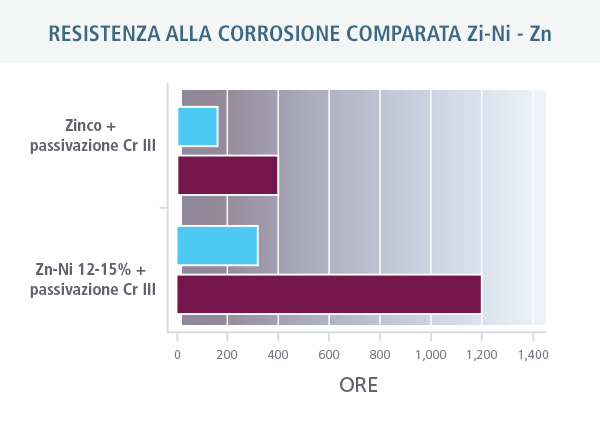
Hours spent before white and red corrosion compared between the twoncoatings Increased wear resistance: a hard and thin Zn-Ni coating has a uniform and smooth finish that increases wear resistance,reducing both friction and the possibility of abrasion.
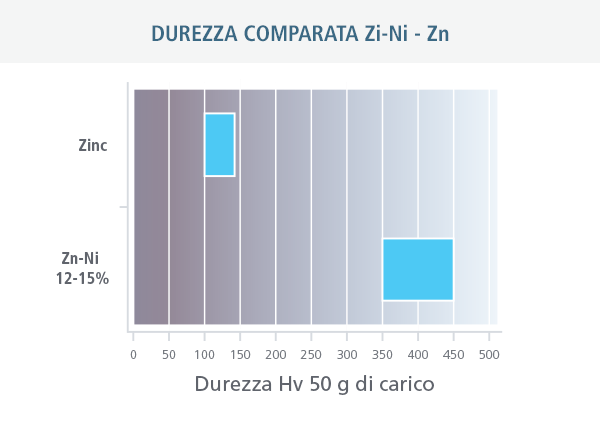
On the Vickers hardness scale, the parts coated with Zn-Ni also reach 450 Hv, compared to less than 150 for parts coated with zinc.
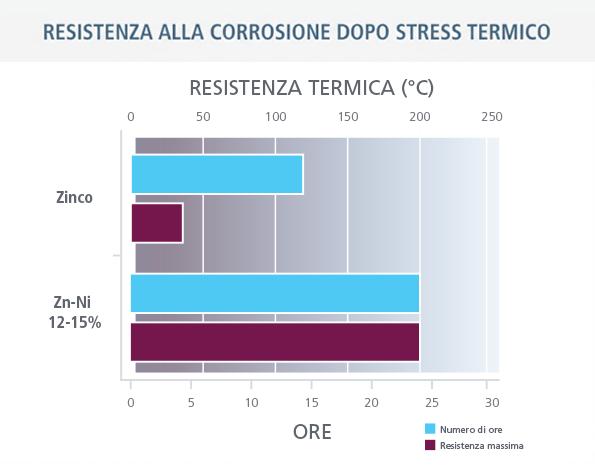
Resistance to thermal stress: zinc nickel coatings provide greater protection against thermal stresses. The tests show that the components coated with Zn-Ni maintain their resistance to corrosion, despite exposure to thermal stresses up to 300 ° C. The parts coated with zinc instead resist thermal stresses up to only 120 ° C and then lose corrosion resistance.
Successful cases:
Zn-NiI zinc nickel coatings can provide a much higher degree of substrate protection, which means that they can withstand the stresses that inevitably shorten the life of the components, from equipment with moving parts to buildings and infrastructure .
There are some industries, including the automotive and aerospace industries, have already widely adopted these coatings. Others, such as constructors of construction, agriculture and power transmission equipment, are beginning to exploit them to protect the value of their products. Agricultural and construction equipment is continuously exposed to time and often to corrosive fertilizers, herbicides and road chemicals.
Zn-Ni-treated carbon steel can also be used to replace more expensive materials used to resist corrosion. In many industries, machine builders have replaced it with stainless steel to increase corrosion resistance. Carbon steel with Zn-Ni coating can reduce component weight as well as control costs.